Noise in Yarra
Information on noise complaints from entertainment venues, commercial buildings sites, neighbours, equipment or waste collection.

Noise is always around us, whether from a natural source or from human activity, and in every community, there are different sources of noise and levels of tolerance to the impacts of noise.
A build-up of unreasonable noise can have significant impacts on the wellbeing of people, as well as animals.
Learn what you can do, what Council’s role is, and where other authorities can help you to address unreasonable noise within the Yarra.
What is unreasonable noise?
Yarra is a diverse and dense city where people live, work, shop, entertain and relax. At times there will be high levels of noise created, and this should be expected as part of living in a thriving city. This is called ‘reasonable’ noise.
It is recognised though, that exposure to too much loud noise over long periods of time can reduce a person’s quality of life, so it’s important to be considerate of others when creating noise, even if it would be considered a reasonable action, particularly during the day.
Any noise could transition from being reasonable to unreasonable, and in determining whether this has occurred, the following factors would be considered for the noise:
- is it occurring during the week or on the weekend
- the time of day
- the volume of noise
- how long the noise lasts
- where the noise is coming from
- what type of noise it is
- where the noise can be heard (where inside your residence)
- whether there is there a strict prohibition requirement in legislation.
Generally, unreasonable noise will be more than something that is just annoying to you. Everyone can be annoyed by noise, and Council cannot respond to every minor irritant that is not unreasonable.
In Yarra, you will likely hear noise from a variety of sources.
Below, you can find out more about these noise sources and who to contact to help you resolve unreasonable noise from these sources.
Sources of noise
You may hear noise coming from an apartment, house or other residential property that you believe to be unreasonable. This could be from music, tv’s, air conditioners and power tools.
The Environment Protection Act 2017 creates an offence to cause unreasonable noise from any residential premises. Residential noise issues arise where the noise is generated from one residential property and is impacting another residential property.
Noise not originating from a residential source but impacting a residential property is not considered residential noise.
Who responds to residential noise issues?
You should contact Yarra for most residential noise issues. Council will be more likely to intervene if the noise is happening all, or most of the time, or if it occurs as a regular pattern over a period of time.
You should contact Victoria Police if the noise is coming from an event that only happens once, or very infrequently (like a party).
Yarra cannot respond to noise from anti-social behaviour, such as yelling, screaming or use of offensive language. If this behaviour makes you feel unsafe, you should report the issue to Victoria Police.
Tips in responding to residential noise
Many people are reluctant to talk with their neighbours or those creating noise for fear of retaliation, however the best first step to resolve any issues is to engage directly with your neighbours. This will often resolve the issue quicker and with less tension that if Council gets involved.
In some circumstances, residential noise can be considered unreasonable at any time of day. Just because the noise can be created during the day, doesn’t mean that there aren’t restrictions on how loud and how long it can occur.
Noise associated with the construction, demolition or removal of residential dwellings is not considered ‘residential noise’ for the purposes of enforcement. Instead, noise from these activities is assessed under the General Environmental Duty (GED) and as unreasonable noise from non-residential premises.
There will be times and days where getting a construction site ready for the day might disturb people if this creates too much noise early in the morning, and there will be restrictions on how early this activity can commence. Additionally, the use of and other power tools may be restricted. Clause 49 [ PDF, 732.42 KB] of Council General Local Law outline days and times where building works cannot occur without a permit.
If you are conducting repairs or maintenance to your home and not significant construction or demolition, this would be considered residential noise and you will need to ensure this noise occurs within the prescribed hours and at a reasonable level.
Who responds to unreasonable noise from non-residential premises?
You should contact Council in the first instance with concerns around residential construction and demolition noise as there may be controls in place through Council issued permits or the General Local Law.
Tips in responding to non-residential noise
If you are planning on doing some construction work, you should let your neighbours know and keep them informed throughout the activity, particularly when noisy activity is expected. You could also:
- restrict work and vehicle movements to normal working hours
- scheduling noisy activities for less sensitive times
- displaying signs with contact details for the builder or project manager
- using the least noisy equipment or technique to do a job
- keeping site and car radios close to workers and at a low volume.
Noise associated with commercial and industrial businesses is generally related to factories, offices, shops and utility infrastructure. It does not include commercial construction noise.
Generally, this noise will be limited by the General Environmental Duty (GED) and noise limits set for the type of business generating the noise.
Businesses are also responsible for noise made by contractors or tradespeople they hire.
Noise limits apply to commercial, industrial and trade premises of all sizes. These noise limits will depend on factors such as land use zone in the planning scheme, location of noise sensitive areas, existing background noise, the time of day the noise occurs, and noise generated from other businesses nearby.
It should be noted that residents who chose to abut or reside within commercial zoning are reasonably expected to experience higher levels of noise than those surrounded by residential zoning.
Who responds to commercial and industrial noise?
Commercial, industrial and trade noise is jointly regulated by Council and the EPA. Investigations are usually carried out by Council’s Planning Investigations or Local Laws Units where there are conditions contained on the premises planning permit or there is a breach of the General Local Law.
Where there are no conditions in place relevant to the noise, the EPA will lead the investigation and response.
Tips in responding to commercial and industrial noise
If you're disturbed by noise from a commercial property, speak to the business that is causing the noise as soon as the problem arises. Businesses may not be aware that the noise they are creating is affecting nearby residents.
Bringing this to their attention will not only make business operators aware of your concerns but they are also more likely to be more considerate in future.
Noise from deliveries to commercial businesses can be disturbing particularly where this noise occurs very early in the morning.
There are restrictions under Clause 58 [ PDF, 732.42 KB] of the General Local Law preventing the delivery of items to a commercial business from a commercial enterprise, or from allowing a refrigeration unit mounted on a vehicle to run, outside prescribed days and times.
Who responds to delivery and collection noise?
You should contact Council with concerns around commercial delivery and collection noise to ensure requirements of the General Local Law have been complied with.
Tips in responding to commercial and industrial noise
If you're disturbed by noise from deliveries, speak to the business that is causing the noise as soon as the problem arises.
Businesses may not be aware that the noise they are creating is affecting nearby residents.
Bringing this to their attention will not only make business operators aware of your concerns but they are also more likely to be more considerate in future.
There are a range of entertainment and sporting venues within the City of Yarra and many people in our community like having multiple options for entertainment. Noise from these venues typically relate to music levels, crowds and their movement, and poor sound insulation.
Music from indoor and outdoor entertainment venues and events can include:
- Live or recorded music
- Voices, including singing and DJ announcements
- Other amplified sounds and sound effects that happen with music.
Loud music from entertainment venues can be frustrating, especially when the noise occurs late into the night.
Compliance with Environment Protection policy is commonly within a venues liquor licence and may also be within the premises planning permit. To view a premises liquor licence please visit the Liquor Control Victoria website.
Who responds to entertainment venue noise?
If you are experiencing repeated issues with noise from a music venue such as a bar or nightclub, you should contact Council to determine whether there is a planning permit and conditions in place that regulate noise.
If there is no planning permit conditions relating to noise, you can contact Liquor Control Victoria to investigate your issues.
If your issue is irregular or infrequent and occurrences after business hours, and you are after an immediate response, Victoria Police are best suited to attend venues when the noise is occurring.
The EPA may respond to venue noise when there are no other authorities that can respond to the noise.
Tips in responding to entertainment venue noise
If you're disturbed by noise from an entertainment venue, speak to the business that is causing the noise as soon as the problem arises. Businesses may not be aware how the noise they are creating is affecting nearby residents.
Bringing this to their attention will not only make business operators aware of your concerns but they are also more likely to be more considerate in future.
Additional information:
Music Victoria, in collaboration with Creative Victoria and the State Government, has developed a noise regulation guide for businesses to assist them
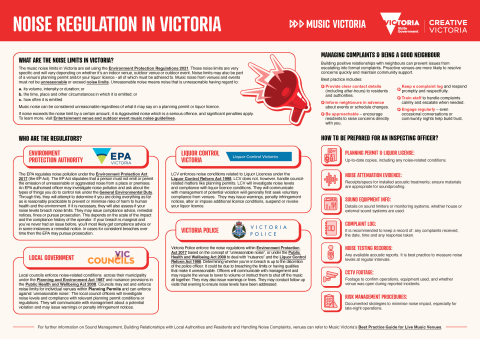
Click to download the Noise Regulation Guide
Our halls and venues are used for community and recreation activities like classes and social group activities. They are also hired out for events, performances and parties. Each hall and venue will have set operating hours, and times that loud music must stop.
Noise from sporting pavilions or facilities
A sporting club that hires one of our sporting pavilions or facilities is responsible for making sure the noise levels from their event meets the noise guidelines. Noise that is made louder with music or other electronic assistance is not allowed at our sporting pavilions and facilities during the following times:
- Monday to Thursday before 7 am and after 10 pm
- Friday before 7 am and after 11 pm
- Saturday and public holidays before 9 am and after 11 pm
- Sunday before 9 am and after 10 pm
We also ask that everyone leaves the pavilion or facility by 11pm, so people who live in the area are not disturbed.
Who responds to entertainment venue noise?
You can report noise from a Council Hall and venue directly to Yarra. Your complaint will be managed by the relevant Council team depending on the type of facility involved.
If it is a one-off event occurring out of business hours you can also contact Victoria police for an immediate response.
Tips in responding to noise from Council halls and venues
If you're disturbed by noise from a Council Hall or Venue, consider approaching the group that is causing the noise. While they are having a good time, they may not be aware how the noise they are creating is affecting nearby residents.
It may also be beneficial to contact the group later if they frequently use the site to talk with them about how to hold future events with less noise impacts.
There are restrictions through the Environment Protection Act that could be applied to noise generated from security alarm systems from residential premises, however there are no restrictions relating to security alarm noise from commercial or industrial businesses.
Who responds to security alarm noise?
Security alarms on both premises and vehicles should in the first instance be reported to Victoria Police by calling 000 if you believe they are sounding due to an intruder.
In all other cases, contact the property owner or their nominated representative to raise a security alarm noise complaint.
Tips in responding to noise from intruder alarms
Only approach the site when the alarm is activated where it is safe to do so. If you are unsure whether it is safe, contact the Police to respond to the noise.
Should the alarm be sounding repeatedly, if safe to do so it is best to try and approach the owner/resident regarding the noise as they may not be aware the issue is occurring.